Mr Damian McKay
We have a team of locally based Consultant Gastroenterologists and Hepatobiliary Surgeons who can deliver an examination, diagnosis and ultimately treatment of conditions in the oesophagus, stomach, large and small intestines (bowel) and biliary system.
Access Endoscopy and Colonoscopy procedures within 7 days at Kingsbridge.
Follow Carol’s experience as she attends Kingsbridge Diagnostic & Treatment Centre in Belfast to receive an urgent scope procedure.
Costs can vary depending on the procedure and your personal treatment plan. We’ll give you a clear price guide upfront and explain what’s included.
Flexible payment options are available to help spread the cost. Our team is here to answer questions and help you choose the best way to pay.
Treatment from:
£2,320.00
Prices accurate as of February 2026 and may be subject to change.
Finance from:
£56.10 per month
Explore Finance Options*Representative Example: Total amount of Credit £2,320.00. Total charge for credit £1,046.00. Total Amount Repayable £3,366.00. Repayable by 60 monthly payments of £56.10. Representative 16.9% APR. Example based upon treatment costing £2,320.00 repayable over 60 months. Acceptance is subject to status. Terms and conditions apply.
Our team will support you through every stage, from your first enquiry to your recovery.
If you’re using health insurance
If you’re paying for treatment yourself or using a payment plan
To make things easier, you can book a new consultation appointment online.
Each site is equipped with modern facilities and experienced teams who will look after you throughout your treatment and recovery.
Our hospitals are easy to reach and offer a calm, comfortable environment to support your care. Wherever you decide to go, you’ll receive the same high standard of personalised treatment.
Colorectal Cancer Screening: Colonoscopy is one of the most effective methods for screening and detecting colorectal cancer. It can identify polyps or other abnormal growths in the colon that could potentially develop into cancer over time.
Polyp Detection and Removal: Polyps are small growths that can develop on the inner lining of the colon. While most polyps are benign, some can become cancerous over time. During a colonoscopy, any polyps found can be removed, reducing the risk of cancer development.
Change in Bowel Habits: If you experience changes in bowel habits, such as persistent diarrhoea, constipation, or changes in stool consistency, a colonoscopy can help diagnose the underlying cause.
Rectal Bleeding: If you have unexplained rectal bleeding, such as blood in your stool or rectal bleeding, a colonoscopy can help identify the source of the bleeding. Bright red bleeding is typically caused by haemorrhoids.
Abdominal Pain: Chronic abdominal pain, especially if it’s accompanied by other symptoms like weight loss or anaemia, might warrant a colonoscopy to investigate potential causes.
Inflammatory Bowel Disease (IBD) Diagnosis and Monitoring: Colonoscopy can help diagnose and monitor conditions like Crohn’s disease and ulcerative colitis by assessing the extent and severity of inflammation in the colon.
Anaemia of Unknown Cause: If you have unexplained anaemia (low red blood cell count), a colonoscopy can be used to check for sources of chronic bleeding in the gastrointestinal tract.
Family History of Colorectal Cancer or Polyps: If you have a family history of colorectal cancer, polyps, or certain genetic conditions that increase the risk of these conditions, your doctor might recommend earlier or more frequent colonoscopy screenings.
Positive Faecal Occult Blood Test (FOBT): If a faecal occult blood test indicates the presence of blood in your stool, a colonoscopy is often performed to determine the source of the bleeding.
Unexplained Weight Loss: Significant and unexplained weight loss, particularly when accompanied by gastrointestinal symptoms, could be a reason for a colonoscopy to investigate potential causes.
Follow-Up for Previous Abnormal Findings: If a previous imaging test, like a CT scan or barium enema, revealed abnormalities in the colon, a colonoscopy might be recommended for a more detailed evaluation.
In many cases a polyp (a projecting growth of tissue) is the cause of the problem, however our Endoscopists at Kingsbridge Private Hospital may be able to remove it during the procedure. Samples may be sent for examination to rule out other possible illnesses or conditions.
A colonoscopy is a safe procedure and the risk of complications is usually low (less than 5 in 1000)
Possible complications of a colonoscopy include an infection in the part of the body that the scope is used to examine and excessive bleeding.
At Kingsbridge, you’ll be in the expert hands of the UK and Ireland’s top General Surgeons.
Discover the main symptoms of lower GI & Colorectal Cancer and why there is no reason to be scared of a Colonoscopy procedure.
Knowing what happens at each stage of a colonoscopy can help you feel prepared and more at ease. Here’s what you can expect:
Before a Colonoscopy
The colon must be free of solid matter for the test to be preformed properly. For 1-3 days, you may be required to follow a low fiber or clear-liquid only diet. Clear fluids include apple juice, chicken and/or beef broth or bouillon, lemon-lime soda, lemonade, sports drinks and water.
It is very important that you remain hydrated during this time. Sports drinks are recommended as they contain electrolytes which are depleted during the purging of the bowel. Orange juice, prune juice, and milk containing fiber should not be consumed, nor should liquids dyed red, purple, orange, or sometimes brown; however, cola is allowed. In most cases, tea (no milk) or black coffee (no milk) are permitted before your examination.
The day before the colonoscopy, you will be given a laxative preparation to help clear the bowel and allow clear examination.
During a Colonoscopy
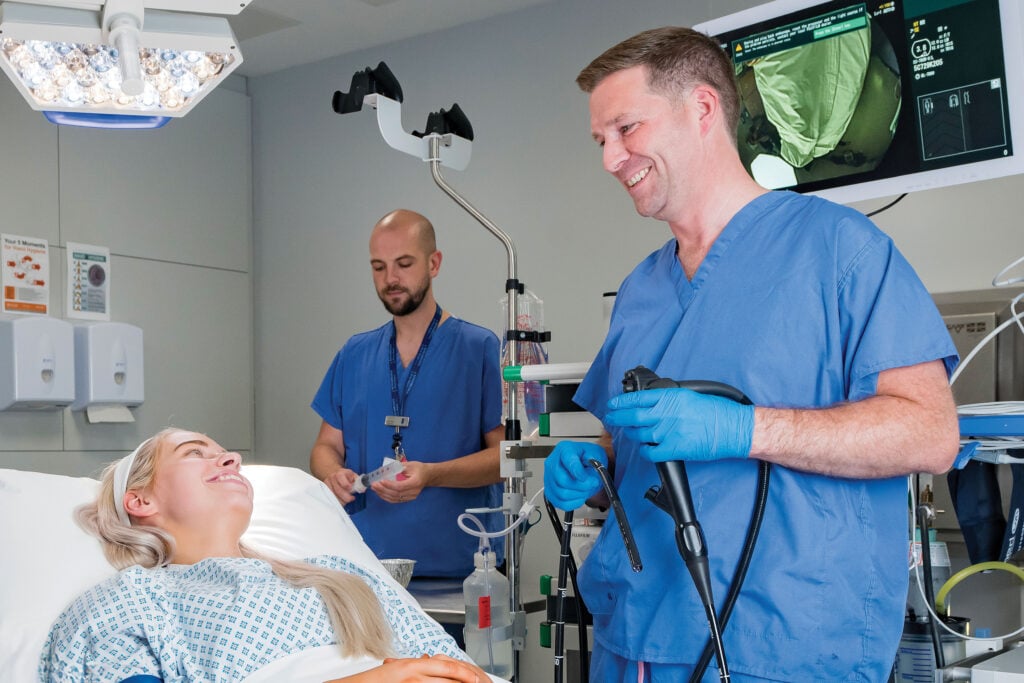
A colonoscopy usually takes between 20-30 minutes. The procedure involves placing a flexible telescope into the back passage and blowing some air into the large bowel to get a clear view. This allows problems such as inflammation or polyps to be clearly identified. Biopsies and photographs may be taken to help make the diagnosis.
If appropriate, you may be offered a sedative or painkiller if required.
Your consultant will advise you on the best course of treatment as well as answer any questions or concerns you have about the procedure.
Alternative to a Colonoscopy
Other options include a barium enema (an x-ray test of the large bowel) or a CT colography (a special scan of the large bowel). At your appointment this will be discussed with you in full and our Consultants will advise on the best course of treatment or investigation to best suit your individual needs.